
Rules
Choose your race format to see the matching rules.
Sprint rules
Sprint Series rules
2H30 Endurance rules
JPR Endurance Cup · specific rules applying to the event. The organiser reserves the right to make any changes deemed necessary before or during the event.
Event format
A Timed qualifying
30 minutes. Start from the pits: the first lap is not timed. The team's best lap sets the starting grid.
B Endurance Cup
2 hours of racing. The team that completes the most laps wins.
Before the race
1 Drivers and team
- Minimum age: 18 (under 18 possible after driver training).
- Team of 2 to 6 drivers.
- Knowledge of the circuit strongly recommended.
2 Registration and payment
Full payment online. For another payment method, email us with your billing details and proof of transfer. No booking without payment.
3 Equipment
- Helmet lent by the circuit.
- Closed shoes mandatory.
- Race suit not mandatory, but arms and legs must be covered (rain gear if needed).
- No race suits to borrow.
4 Results and standings
SWS ranked race (cumulative). Create your team on Sodi World Series if needed, then pre-register it for the race on the SWS website.
Go to SWS5 Minimum weight and numbers
- Weigh-in in racing gear, without helmet or rib protector.
- Driver weight + ballast: 80 kg minimum.
- A wristband shows the ballast to carry. Only the circuit's ballast is allowed.
- Race numbers are drawn at random before qualifying and before the start.
6 Planning your stints
Agree on the pace of your stops. The time shown is the time left to drive. Call your driver in with the numbered board lent by the circuit.
Live timing iOS app Android appPit stops and stints
7 The next driver must be ready
- Helmet strapped on, ready to get into the kart as soon as called.
- No valuables in open pockets (phone, keys…).
- Place the board against the fence for the next stop.
8 Pit entry and moving in the pits
- The pit entry is shown at the briefing.
- Keep to a sensible speed in the pit lane.
- The asphalt lane is for driving; stop the kart on the concrete area.
- Pedestrians stay behind the TECPRO barriers (red and white blocks).
- A team member signals the driver to leave, to respect the minimum pit time.
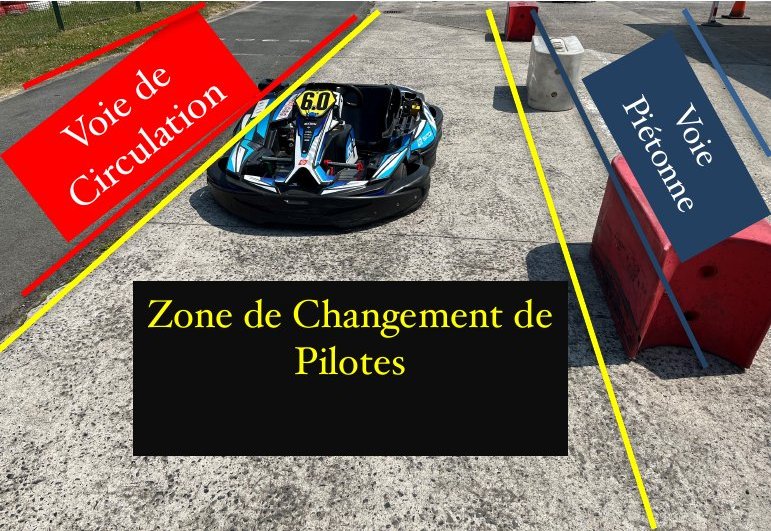
9 Start and finish
Specific instructions are given at the briefing.
10 Mandatory pit stops
3 stops minimum
The number of stops is counted by the timing system. A driver change is mandatory at every stop (except in special cases, ask us).
11 Kart change (Quick Change)
For fairness, you change kart while keeping your race number. During the endurance race, this change replaces refuelling. Follow the team's instructions and stay in your assigned coloured lane.
During qualifying
1 kart change possible, not required at every stop.
During the endurance race
- Kart change required at every stop, in the technical zone.
- No driver change in the technical zone.
- The driver moves their ballast into the new kart; the team moves the plate and transponder.
- You then make your driver change.
The kart change is included in the stop time. When it's busy, you may lose time: choosing the right moment is part of the strategy.
12 Stint length and pit lane opening
- A stint lasts between 15 and 50 minutes.
- Only the circuit's timing (Pit In – Pit Out) is binding.
- Pit lane closed during the first and last 15 minutes, except in an emergency.
13 Pit stop time
2 min 00 minimum
In qualifying and in the race. Drive slowly and steadily so you can stop if a pedestrian is in front of you; the acceleration line is shown at the briefing. A screen and the live timing show the length of your stop.
14 Drive time per driver
Each driver must drive between −25% and +25% of the total race time divided by the number of drivers.
Example for a 2-hour race and 4 drivers: 120 ÷ 4 = 30 min, so between 22 min 30 and 37 min 30 per driver.
15 · Penalties
Progressive penalties depending on the number of offences
| Offence | 1st | 2nd | 3rd | 4th | 5th |
|---|---|---|---|---|---|
| Exceeding track limits | Warning | 2 s | 5 s | 15 s | 30 s |
| Breaking safety rules | Warning | 15 s | 30 s | 1 lap | |
| Loss of control, unsporting or dangerous driving with consequences | 15 s | 30 s | 1 lap | ||
| Pit lane speeding | 15 s | 30 s | 1 lap | ||
| Locking up or sliding in the pit lane | 15 s | 30 s | 1 lap | ||
| Spinning at the pit entry | 15 s | 30 s | 1 lap | ||
| Unsafe pit release (not giving way to karts on track) | 15 s | 30 s | 1 lap |
Fixed penalties
| Offence | Penalty |
|---|---|
| Number of pit stops not respected | 5 laps per missing stop |
| Missing pit stop time (up to 10 s) | Missing seconds × 5 |
| Missing pit stop time (over 10 s) | 1 lap |
| Missing pit stop time (over 40 s) | 2 laps |
| Driver change while the pit lane is closed | 1 lap |
| Ballast not respected | 1 lap per 2.5 kg missing |
| Non-compliant check weigh-in | 1 lap per kg difference (from 1 kg) |
| Drive time per driver not respected | 10 s per minute over |
| Maximum stint time exceeded | 30 s per minute started |
| Minimum stint time not reached | 30 s per minute not completed (except the last stint if pit entry is before the last 15 minutes) |
- Time penalties become grid places: 15 s = 2 places, 30 s = 4 places, 1 lap = 10 places.
- Ballast error: all laps of the stint concerned are cancelled.
- Exceeding track limits: the laps concerned are cancelled.
Penalties are applied directly in the timing software: no stop and go.
Your questions are welcome at the end of the briefing, and the team is available throughout the endurance race.
Good luck!
6H40 Endurance rules
JPR Endurance Cup · specific rules applying to the event. The organiser reserves the right to make any changes deemed necessary before or during the event.
Event format
A Timed qualifying
Pit lane start: the first lap is not timed. The team's best lap sets the starting grid. The session lasts exactly 42 minutes.
B Endurance Cup
The team that completes the most laps wins. The exact race duration is 5H58.
Before the race
1 Drivers and team
- Minimum age: 16 (under 16 possible after a driver coaching course).
- Team of 2 to 6 drivers.
- Knowledge of the circuit strongly recommended.
2 Registration and payment
Full payment online. For another payment method, email us with your billing details and proof of transfer. No booking without payment.
3 Equipment
- Helmet lent by the circuit.
- Closed shoes mandatory.
- Race suit not mandatory, but arms and legs must be covered (rain gear if needed).
- No race suits to borrow.
4 Results and standings
SWS ranked race (cumulative). Create your team on Sodi World Series if needed, then pre-register it for the race on the SWS website.
Go to SWS5 Minimum weight and numbers
- Weigh-in in racing gear, without helmet or rib protector.
- Driver weight + ballast: 80 kg minimum.
- A wristband shows the ballast to carry. Only the circuit's ballast is allowed.
- Race numbers are drawn at random before qualifying and before the start.
6 Planning your stints
Agree on the pace of your stops. The time shown is the time left to drive. Call your driver in with the numbered board lent by the circuit.
Live timing iOS app Android appPit stops and stints
7 The next driver must be ready
- Helmet strapped on, ready to get into the kart as soon as called.
- No valuables in open pockets (phone, keys…).
- Place the board against the fence for the next stop.
8 Pit entry and moving in the pits
- The pit entry is shown at the briefing.
- Keep to a sensible speed in the pit lane.
- The asphalt lane is for driving; stop the kart on the concrete area.
- Pedestrians stay behind the TECPRO barriers (red and white blocks).
- A team member signals the driver to leave, to respect the minimum pit time.
9 Start and finish
Specific instructions are given at the briefing.
10 Mandatory pit stops
The number of stops is counted by the timing system. A driver change is mandatory at every stop (except in special cases, ask us).
Racing10 stops- 2 drivers minimum (up to 6)
- Intercom allowed
- On-board lap timers allowed
- 3 drivers minimum (up to 6)
- Pit calls by pit board only
- No on-board lap timers
11 Kart change (Quick Change)
For fairness, you change kart while keeping your race number. During the endurance race, this change replaces refuelling. Follow the team's instructions and stay in your assigned coloured lane.
During qualifying
1 kart change possible, not required at every stop.
During the endurance race
- Kart change mandatory at every stop, in the technical area (full tank).
- No driver change in the technical zone.
- The driver moves their ballast into the new kart; the team moves the plate and transponder.
- You then make your driver change.
The kart change is included in the stop time. When it's busy, you may lose time: choosing the right moment is part of the strategy.
12 Stint length and pit lane opening
- A stint lasts between 15 and 50 minutes.
- Only the circuit's timing (Pit In – Pit Out) is binding.
- Pit lane closed during the first and last 15 minutes, except in an emergency.
13 Pit stop time
2 min 30 minimum
In qualifying and in the race. Drive slowly and steadily so you can stop if a pedestrian is in front of you; the acceleration line is shown at the briefing. A screen and the live timing show the length of your stop.
14 Drive time per driver
Each driver must drive between −25% and +25% of the total race time divided by the number of drivers.
Example for a 6H00 race with 4 drivers: 360 ÷ 4 = 90 min, i.e. between 67 min 30 and 112 min 30 per driver.
15 · Penalties
Progressive penalties depending on the number of offences
| Offence | 1st | 2nd | 3rd | 4th | 5th |
|---|---|---|---|---|---|
| Exceeding track limits | Warning | 2 s | 5 s | 15 s | 30 s |
| Breaking safety rules | Warning | 15 s | 30 s | 1 lap | |
| Loss of control, unsporting or dangerous driving with consequences | 15 s | 30 s | 1 lap | ||
| Pit lane speeding | 15 s | 30 s | 1 lap | ||
| Locking up or sliding in the pit lane | 15 s | 30 s | 1 lap | ||
| Spinning at the pit entry | 15 s | 30 s | 1 lap | ||
| Unsafe pit release (not giving way to karts on track) | 15 s | 30 s | 1 lap |
Fixed penalties
| Offence | Penalty |
|---|---|
| Number of pit stops not respected | 5 laps per missing stop |
| Missing pit stop time (up to 10 s) | Missing seconds × 5 |
| Missing pit stop time (over 10 s) | 1 lap |
| Missing pit stop time (over 40 s) | 2 laps |
| Driver change while the pit lane is closed | 1 lap |
| Ballast not respected | 1 lap per 2.5 kg missing |
| Non-compliant check weigh-in | 1 lap per kg difference (from 1 kg) |
| Drive time per driver not respected | 10 s per minute over |
| Maximum stint time exceeded | 30 s per minute started |
| Minimum stint time not reached | 30 s per minute not completed (except the last stint if pit entry is before the last 15 minutes) |
- Time penalties become grid places: 15 s = 2 places, 30 s = 4 places, 1 lap = 10 places.
- Ballast error: all laps of the stint concerned are cancelled.
- Exceeding track limits: the laps concerned are cancelled.
Penalties are applied directly in the timing software: no stop and go.
Your questions are welcome at the end of the briefing, and the team is available throughout the endurance race.
A photographer captures your best racing moments.
A food truck is on site for lunch.
Good luck!
8H40 Endurance rules
JPR Endurance Cup · specific rules applying to the event. The organiser reserves the right to make any changes deemed necessary before or during the event.
Event format
A Timed qualifying
40 minutes. Start from the pits: the first lap is not timed. The team's best lap sets the starting grid.
B 1re Endurance Cup
4 hours, anticlockwise.
C 2e Endurance Cup
4 hours, clockwise. The team that completes the most laps wins.
Before the race
1 Drivers and team
- Minimum age: 18 (under 18 possible after driver training).
- Team of 2 to 6 drivers.
- A driver can only belong to one team.
- No change to the line-up after the briefing, unless authorised by the race director.
- Knowledge of the circuit strongly recommended.
2 Registration and payment
Full payment online. For another payment method, contact us. No booking without payment.
3 Equipment
- Helmet lent by the circuit.
- Closed shoes mandatory.
- Race suit not mandatory, but arms and legs must be covered (rain gear if needed).
- No race suits to borrow.
4 Results and standings
SWS ranked race (cumulative). Create your team on Sodi World Series if needed, then pre-register it for the race on the SWS website.
Go to SWS5 Minimum weight and numbers
- Weigh-in in racing gear, without helmet or rib protector.
- Driver weight + ballast: 80 kg minimum.
- A wristband shows the ballast to carry. Only the circuit's ballast is allowed.
- Race numbers are drawn at random before qualifying and before the start.
6 Planning your stints
Agree on the pace of your stops. The time shown is the time left to drive. Call your driver in with the numbered board lent by the circuit.
Live timing iOS app Android appPit stops and stints
7 The next driver must be ready
- Helmet strapped on, ready to get into the kart as soon as called.
- No valuables in open pockets (phone, keys…).
- Place the board against the fence for the next stop.
8 Pit entry and moving in the pits
- The pit entry is shown at the briefing.
- Drive at walking pace in the pits.
- The asphalt lane is for driving; stop the kart on the concrete area.
- Pedestrians stay behind the TECPRO barriers (red and white blocks).
- A team member signals the driver to leave, to respect the minimum pit time.
9 Start and finish
- Specific instructions are given at the briefing.
- 1er départ (par défaut) : type « Le Mans », les pilotes s'élancent assis dans le kart.
- 2e départ : en grille classique, ou départ lancé sur une seule ligne.
10 Mandatory pit stops
7 stops minimum
Per Endurance Cup. Stops are counted by the timing system. A driver change is required at every stop (unless there is a specific problem, ask us).
11 Kart change (Quick Change)
For fairness, you change kart while keeping your race number. During the endurance race, this change replaces refuelling. Follow the team's instructions and stay in your assigned coloured lane.
During qualifying
1 kart change possible, at the team's choice, not required at every stop.
During the endurance race
- Kart change mandatory at every stop, in the technical area (full tank).
- No driver change in the technical zone.
- The driver moves their ballast into the new kart; the team moves the plate and transponder.
- You then make your driver change.
The kart change is included in the stop time. When it's busy, you may lose time: choosing the right moment is part of the strategy.
12 Stint length and pit lane opening
- A stint lasts between 15 and 50 minutes.
- Only the circuit's timing (Pit In – Pit Out) is binding.
- Pit lane closed during the first and last 15 minutes, except in an emergency.
13 Pit stop time
2 min 30 minimum
In qualifying and in the endurance race. Stop time is measured automatically between the two timing loops in the pits (see the paddock map below). Drive slowly and steadily so you can stop for a pedestrian; the acceleration line is shown at the briefing. A screen and the live timing show how long your stop lasts.
14 Drive time per driver
Each driver must drive between −25% and +25% of the total race time divided by the number of drivers.
Calculated for each 4-hour Endurance Cup. Example for 4 drivers: 240 ÷ 4 = 60 min, so between 45 min and 75 min per driver.
15 · Penalties
Progressive penalties depending on the number of offences
| Offence | 1st | 2nd | 3rd | 4th | 5th |
|---|---|---|---|---|---|
| Exceeding track limits | Warning | 2 s | 5 s | 15 s | 30 s |
| Breaking safety rules | Warning | 15 s | 30 s | 1 lap | |
| Loss of control, unsporting or dangerous driving with consequences | 15 s | 30 s | 1 lap | ||
| Pit lane speeding | 15 s | 30 s | 1 lap | ||
| Locking up or sliding in the pit lane | 15 s | 30 s | 1 lap | ||
| Spinning at the pit entry | 15 s | 30 s | 1 lap | ||
| Unsafe pit release (not giving way to karts on track) | 15 s | 30 s | 1 lap |
Fixed penalties
| Offence | Penalty |
|---|---|
| Number of pit stops not respected | 5 laps per missing stop |
| Missing pit stop time (up to 10 s) | Missing seconds × 5 |
| Missing pit stop time (over 10 s) | 1 lap |
| Missing pit stop time (over 40 s) | 2 laps |
| Driver change while the pit lane is closed | 1 lap |
| Ballast not respected | 1 lap per 2.5 kg missing |
| Non-compliant check weigh-in | 1 lap per kg difference (from 1 kg) |
| Drive time per driver not respected | 10 s per minute over |
| Maximum stint time exceeded | 30 s per minute started |
| Minimum stint time not reached | 30 s per minute not completed (except the last stint) |
- Time penalties become grid places: 15 s = 2 places, 30 s = 4 places, 1 lap = 10 places.
- Ballast error: all laps of the stint concerned are cancelled.
- Exceeding track limits: the laps concerned are cancelled.
Penalties are applied directly in the timing software: no stop and go.
Your questions are welcome at the end of the briefing, and the team is available throughout the endurance race.
Good luck!
Click an area to see its role during the endurance race, or follow the route step by step.
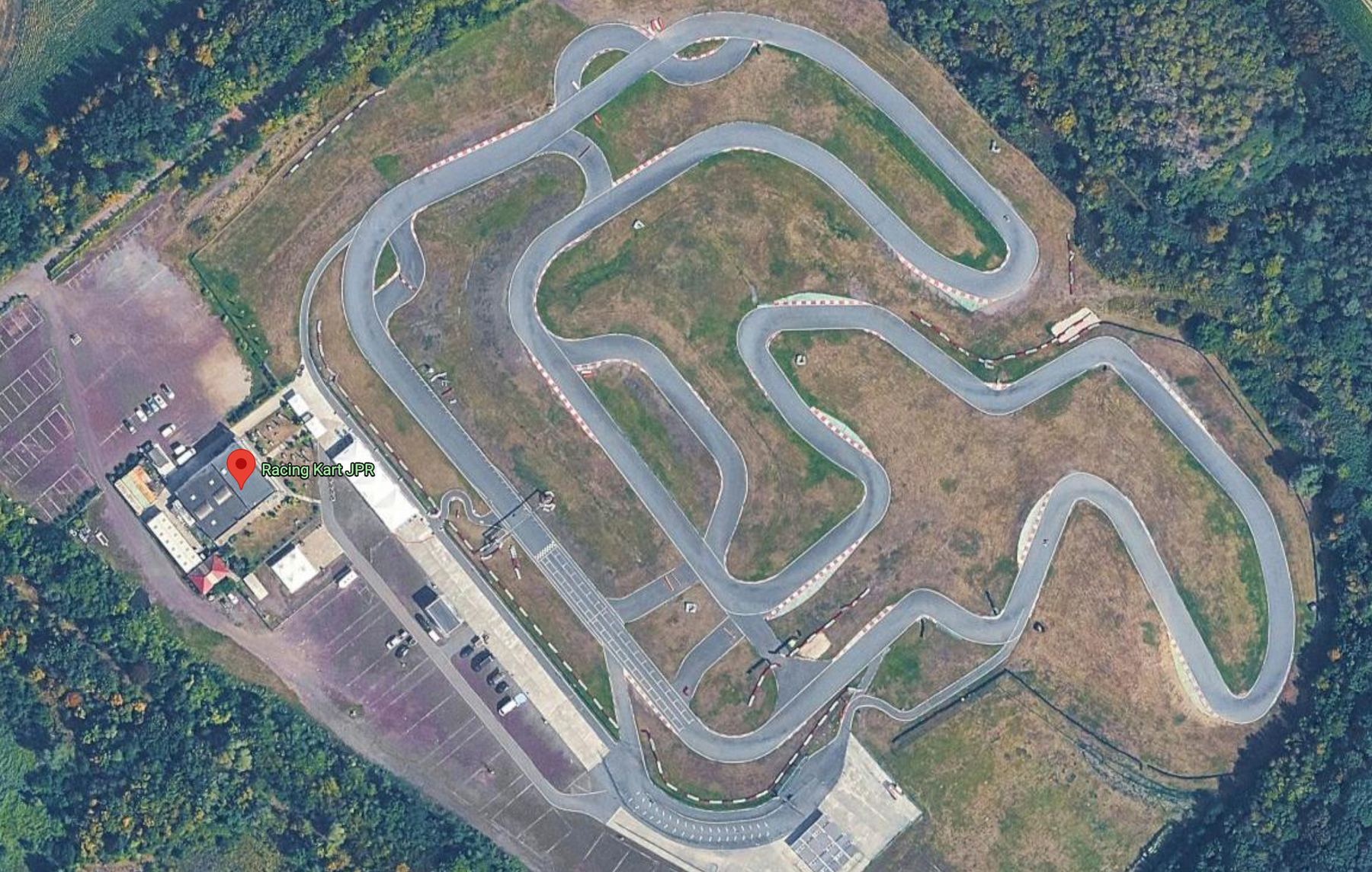
Paddock entrance
- Access to the circuit by car: follow the arrow to the paddock car park.
- Park in the team area to unload your equipment.
Reception / weigh-in / check-in
- Confirmation of the team's registration.
- Weigh-in in racing gear, without helmet or rib protector: 80 kg minimum driver + ballast.
- Un bracelet indique le lest à emporter ; seul le lest du circuit est autorisé.
- Race numbers are drawn at random.
Team area · paddock
- Your base during the race: set up the team and prepare the driver changes.
- The next driver is ready, helmet strapped on, as soon as the kart is called in.
- No valuables in open pockets (phone, keys…).
Espace repas / food truck
- Food on site for drivers and supporters during the event.
Panneautage
- Call your driver in with the numbered pit board lent by the circuit.
- After the stop, put the board back against the fence for the next call.
Pit entry
- Access to the pit lane, shown at the briefing.
- Pit lane closed during the first and last 15 minutes of the race, except in an emergency.
- Pit In starts the timing of the stop: 2 min 30 minimum.
Zone technique
- Kart change mandatory at every stop, with a full tank (it replaces refuelling).
- Stay in the coloured lane assigned to your team.
- No driver change in this area.
Quick change
- The driver moves their ballast into the new kart; the team moves the plate and transponder.
- The driver change happens afterwards.
- When it's busy, choosing the right moment is part of the strategy.
Driving lane (pits)
- The asphalt lane is for driving, at a reasonable speed: you must be able to stop if a pedestrian is in front of you.
- Stop the kart on the concrete area.
- A screen and the live timing show the length of your stop.
Pedestrian lane (pits)
- Pedestrians stay behind the TECPRO barriers (red and white blocks).
- A team member signals the driver to leave once the minimum time has been respected.
Timing area
- Timing line: only the circuit's timing (Pit In – Pit Out) is binding.
- Follow the race live on the live timing or the Racing Kart JPR app.
Pit exit
- Drive slowly and steadily to the acceleration line shown at the briefing.
- Rejoin the track safely.